Saturday, January 8, 2011

Afghan Irrigation

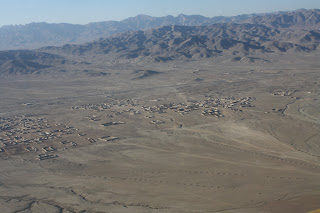
 I finally got some decent overhead shots of something I've been seeing on practically every flight.  You may have to click to enlarge the photos to see what I'm writing about here.  But in all of them, you will see a series of circles leading from the riverbed (now completely dried out) to the farms and town.  This is the traditional rural irrigation system in Afghanistan. It's actually an underground conduit for the water; the circles are holes dug to allow access so that the farmers can keep the channel clean and free of debris or obstruction.  Winter, since it's even drier than other seasons, is the time when they clean out the canals.  The villages collectively manage the system - at least they used to.  One of the good ideas that turned out to be not so great was that of paying the locals to clean out and maintain the canals, warping the way things work and unnecessarily altering a facet of rural life that had functioned pretty well.  You didn't clean out your section of the canal, odds were good that your immediate neighbor downstream was going to whack you upside the head with a shovel to remind you of your responsibility.  Afghanistan isn't a water-rich country, though the drought of recent years has been difficult.  But as one of the Texan aggies said, "Water is gold" here.  Another one of our great ideas, digging wells everywhere to bring the water supply closer, has perversely depleted much of the ground water, creating longer term problems.  Many of the local disputes that go on here have nothing to do with any insurgency; they are long-running fights over water and irrigation rights, land titles (which of course didn't always exist), and fights among herders whose sheep decimate grazing land (especially difficult to resolve when the sheep or goats belong to the nomadic Kuchi).   So anyway, water's a big deal here, and water dynamics are the key to understanding much of rural village events.

More on the Ghazni PRT

 It actually wasn't that cold; it was certainly above freezing.  I guess some soldiers just like to light fires.
Big Daddy's is a meeting room and recreation hall, named after Tom Stefani, a US agricultural agent who was killed in Ghazni in 2007.  There was one small controlled ordinance detonation while we were inside that made the building shake quite a bit.  It would have rattled the windows, but there aren't any to rattle.

Polish PRT

 As mentioned, the Poles are in the lead at the Ghazni PRT.  So I said "jin dobry" to people, then had to switch to Czech because that's about all the Polish I know.  For lunch, there was Polish sausage, though I guess for them it was just called "sausage."  And they still have their Christmas decorations up - though no lights, since it's a blackout PRT given all the incoming fire they take.

Helicopter to Ghazni

 Our flight to Ghazni was delayed for a half hour or so because they weren't sure where we were going.  Apparently the coordinates we'd submitted for the destination were appropriate for some GPS, but not for the one in the helo, and no one could find the latitude-longitude coordinates.  Finally we just said, "Take us to the PRT where you usually go in Ghazni."  That's when we found out that there is also a helo landing zone somewhere out in the middle of nowhere.  That was not our preferred destination.  As you see in the second photo, the helicopter was one of the Russian Mi-8s, and the Russian says "Emergency Exit" or "Jump Out Here" or "Men's Urinal" or something; who knows, the safety card is in Russian, too.  And in the first photo you see a flak jacket cavalierly tossed atop one of the boxes of "explosive material" that was about a foot and a half from my feet.  I'm hoping it was just bullets.

Texas in Afghanistan


 Today I was at the Ghazni PRT.  Ghazni is a province south of Logar (the one immediately south of Kabul); it's pretty "kinetic."  The PRT itself is led by the Poles - see a later post.  But the US component includes a National Guard agricultural team from Texas.  They proudly fly the Texas flag, as you see in the first photo.  Go into their office, and you see barbed wire handing from horse shoes nailed into the wall and cowboy hats hanging from some poor animal's horns.  Most of the group wasn't there - they were "in mourning," we were told, because Texas A&M had just had its ass kicked this morning (for us) by LSU.  The office also has a display of historic Texan flags, including the "Dimmitt" flag in the last photo.  You have to wonder what effect it might have on the PRT's interaction with local Afghans, at least on the insurgents, if the Texas team actually flew the Dimmitt flag when they rode around.

Friday, January 7, 2011

A Little Bang

Kabul itself is pretty safe, though admittedly it's the safety that comes from a massive armed security presence, street stops, checkpoints, barriers, high blast-proof walls, etc.  But a couple of days ago less than half an hour after going to work, there was a little thud.  Turns out there was a bomb near a pedestrian bridge maybe a mile from the Embassy.  As usual, the victims were Afghans, not foreigners; I think one was killed and three more injured.  That's maybe just the fourth or fifth incident in Kabul since we've been here.  Most things happen somewhere else.  Like in Ghazni, a province south of Kabul, where I'm going soon; perhaps I'll find something to take a photo of.  After that, the big project for this blog will be a status report on our stockpile of toiletries.  I believe we're in good shape on shampoo, but I'm starting to worry about the toilet paper.

Sunday, January 2, 2011

New Year

As a morale-boosting measure, since actually giving people the day off on holidays wasn't really a viable option, it was decided by some wiser than me that what our compound most needed on New Year's Eve was a large bonfire.  After all, we're not Texas A&M students.  I concur with the widely-held view that what Kabul most needs, especially during the winter months, is more particulate matter in the atmosphere, since not everyone in the building has yet succumbed to some sort of respiratory problem.  But I vehemently disagree with those who thought that mere piles of wood were sufficient.  And so I made a suggestion to liven up the celebration.  I was quite pleased with the result.  Sure, there's always one lone voice of protest.  I say, Majority rules, as long as I form a part of it.  And so, while you may have seen bowdlerized versions of the bonfire on Fox News, which I understand was here, below is what really happened.  I'm already starting to think of ways to spice up the Presidents' Day events.